Burning. Tingling. Numbness that comes and goes — or never quite leaves. When a nerve is being squeezed, it has a limited vocabulary. And it tends to repeat itself.
If you’ve been living with carpal tunnel syndrome, occipital neuralgia, or another form of nerve entrapment, you’ve probably been offered two paths: manage the symptoms, or think about surgery.
But there’s a middle option more patients are asking about — and more research is supporting. It’s called nerve hydrodissection.
What Is Nerve Hydrodissection?
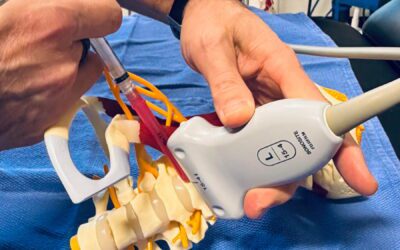
Nerve hydrodissection is a minimally invasive, ultrasound-guided injection technique that uses fluid — not a scalpel — to gently separate a compressed nerve from the tissue pressing on it.
Healthy nerves are designed to glide as you move. When fascia, ligament, or scar tissue binds a nerve in place, even mild pressure can irritate it, restrict the tiny blood vessels that feed it, and change how it fires. Research has shown that peripheral nerves are remarkably sensitive to even light, sustained compression.
During hydrodissection, your provider uses high-resolution ultrasound to watch the nerve in real time, then precisely injects a solution — often 5% dextrose, a mild sugar-water solution — into the space around it. The fluid itself does the work, gently opening a plane between the nerve and the structures compressing it.
The goal isn’t to numb the nerve. It’s to free it.
Isn’t That Just a Nerve Block?
Not quite — and the difference matters.
A traditional nerve block places medication near a nerve, often on one side of it, primarily to interrupt pain signals for a period of time. It’s a valuable tool, but its main job is temporary relief.
True hydrodissection is different. The injectate is guided all the way around the nerve — circumferentially — mechanically separating the tissue planes under continuous ultrasound guidance. On the screen, a successfully released nerve is visibly surrounded by fluid on every side. The aim is to restore the nerve’s ability to glide and to improve the local environment it lives in, not just to quiet it for a while.
What Does the Research Say?
The evidence base here has grown quickly. A 2026 editorial in the medical journal Cureus summarized the current picture: systematic reviews and meta-analyses now support ultrasound-guided hydrodissection as a safe, effective option for focal nerve entrapments — with the strongest evidence in carpal tunnel syndrome, where dextrose hydrodissection has shown meaningful, durable improvement in randomized trials.
Researchers increasingly describe hydrodissection as a bridge: an option that sits between conservative care (splinting, therapy, activity changes) and surgery, for patients who need more than the former but want to avoid — or aren’t ready for — the latter.
As with any procedure, it isn’t a universal answer. Whether it’s a fit depends on which nerve is involved, what’s compressing it, and how your symptoms behave — which is exactly what a careful ultrasound evaluation is for.
Which Nerves Can Be Treated?
Hydrodissection can be considered for many entrapment sites, including:
- The median nerve at the wrist (carpal tunnel syndrome)
- The ulnar nerve at the elbow (cubital tunnel)
- Occipital nerves at the base of the skull, involved in some chronic headaches
- The peroneal nerve at the outer knee
- The tibial nerve at the inner ankle (tarsal tunnel)
It may also have a role for patients with broader peripheral nerve pain — such as diabetic neuropathy — who develop an additional, focal “pinch point” on top of the underlying condition.
What Is the Procedure Like?
Hydrodissection is an in-office procedure that typically takes minutes, not hours. Because the fluid — rather than the needle tip — does the separating, tissues are pushed gently aside, and most patients tolerate it well. Many return to normal light activity quickly; your provider will walk you through what to expect for your specific situation.
And if needles themselves are the hard part? You’re not alone — ask us about Pro-Nox™, a patient-controlled comfort option available with our in-office injection procedures.
A Middle Path Worth Exploring
At NW Regen, hydrodissection is part of a broader regenerative toolkit for nerve-related pain here in Portland — alongside diagnostic ultrasound, prolotherapy, and PRP. If nerve pain has you weighing your options, we’d be glad to help you understand whether a trapped nerve is part of the picture. Contact us to schedule a consultation.
Dr. Ryan Wood, ND, DC, RMSK, is the Founder & Clinical Director of NW Regen. A licensed Naturopathic and Chiropractic physician certified in musculoskeletal sonography, he focuses on interventional orthopedic and orthobiologic medicine — including PRP, prolotherapy, and adipose-derived stem cell therapies — as well as general musculoskeletal and non-surgical orthopedic medicine. He is the West Coast’s leading Stellate Ganglion Block specialist, having performed nearly 3,000 DSR-SGB procedures for trauma, dysautonomia, and post-COVID syndromes since 2017. Dr. Wood is a lecturer and instructor for the Hackett Hemwall Patterson Foundation and the European School of Prolotherapy. He teaches interventional regenerative orthopedics and diagnostic ultrasound and provides hands-on physician training in SGB domestically and internationally. With almost two decades of orthopedic practice across multiple disciplines, he brings extensive experience to the diagnosis and management of complex cases.